GOS Limited · Tokyo · since 2015

We build and rebuild businesses in Japan —
then hand them over ready to run.

We serve as your Representative Director, take full P&L responsibility, and work on fixed project fees — not hourly billing.

BUILD

We set it up

Incorporation, licences, the Representative Director’s seat, the first team, the sales channels.

RUN

We run it

Back office, supply chain planning and English HQ reporting — documented procedures, monthly numbers.

HAND OVER

We hand it over

To your own hires, a successor, or a buyer — a business that demonstrably runs without us.

Issues

Three things we hear from owners about Japan

01

Years of nothing

“We tried a representative office. Two years later, nothing had happened.”

A rep office can research and relate. It cannot sign, hire, or sell. Without someone accountable for a P&L on the ground, Japan stays a line in next year’s plan.

02

Numbers you cannot verify

“Our distributor shows us figures we have no way to check.”

Sales, stock and margin arrive second-hand, in a format that changes when the questions get specific. You own the brand and carry the risk, but somebody else holds the numbers.

03

Advice without a signature

“Everyone advises. Nobody signs.”

Consultants recommend, agencies execute tasks, entity-management firms keep you compliant. None of them puts their name on the company and answers for the result. That is the seat we take.

What we do

Ways we enter

Operate

Building a Japan business

You have decided Japan is worth it, and there is no entity yet — or only a rep office. We incorporate, obtain the licences, hire the first team, open the sales channels, and operate the business as Representative Director until it is ready to hand over.

How we build →

Fix

Fixing an existing Japan business

The entity exists and something is wrong — the numbers are late or unverifiable, the operation leaks cash, the management has left or has to. We step in, stabilise the operation first, then fix it into a state someone can run. Where a business has outgrown its founder, we systemise what lives in one person’s head.

How we fix →

Rebuild

Running critical supply chain operations

For companies already operating in Japan: we rebuild demand and supply planning, inventory control and HQ reporting, and run them as a managed function — bilingual execution, not just advice. This is where eight years of running planning inside a foreign-owned manufacturer live.

Managed SCM Office →

How it works

How we work

  1. We do not leave a proposal behind and go home.

    We work out what the decision is, help you make it, and then do the work that follows. That last part is where consultancies stop.

  2. We do not bill by the hour.

    No hourly rates, no timesheets, no cap on hours. You contract a role for a fixed monthly fee. Your budget is predictable, and you can pick up the phone without doing arithmetic first.

  3. Contracts have no fixed term.

    No minimum period. Notice only. We do not start a relationship on the assumption that it ends.

  4. We report the numbers every month — to your management meeting and to your head office.

    We will not take on execution without the numbers behind it. If the figures are not going to be visible, we are not the right firm.

  5. More than fifty companies, roughly half Japanese-owned and half foreign-owned, since 2015.

    Our managing director spent his career on the operating side before founding GOS: Mitsubishi Corporation (projects in the Middle East and Southeast Asia), a European power-tool manufacturer (building a national distribution network), Fast Retailing (launching UNIQLO’s UK business, based in London), an MBA from Ashridge, L’Oréal Japan (procurement integration), Mars Japan (logistics and supply chain restructuring), and managing director of the Japanese arm of a British recruitment firm.

Deliverables

What lands on your desk

Not slides. These are the actual shapes of our work — monthly, and every morning.

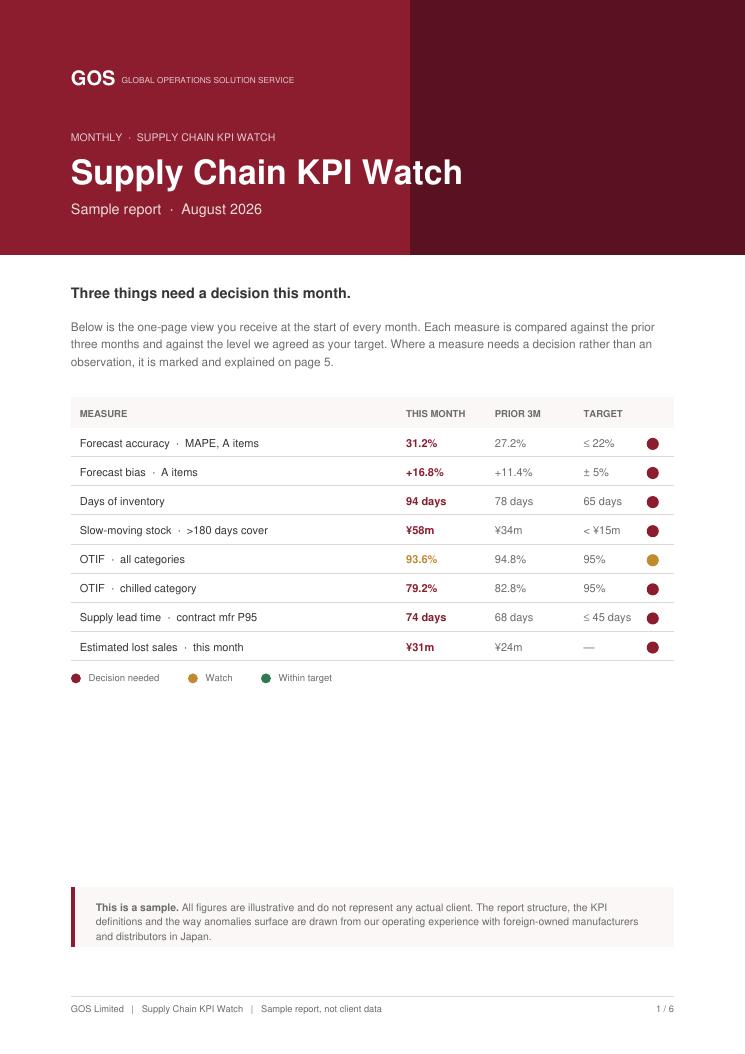
Monthly KPI report cover (sample)
The monthly KPI report (six pages) — request the sample
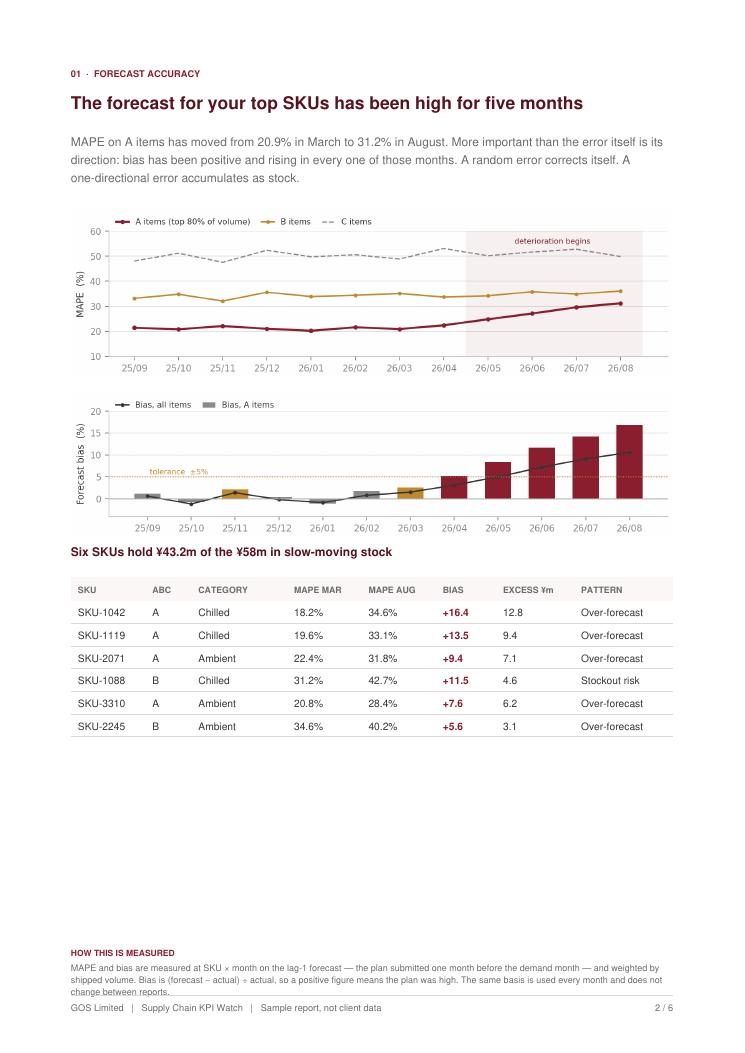
KPI summary page with findings (sample)
Findings with what each one costs — built on your own extracts

MONTHLY REVIEW — fixed format

MeasureLast m.This m.
Forecast accuracy (MAPE)38%31%▲ better
On-time in full (OTIF)79.2%84.5%▲ better
Days of inventory9481▲ better
Slow-moving stock¥58m¥43mact
The monthly review table (sample figures)

Start small

Start small — see the numbers before you commit

Nobody should hire an operating partner on faith. Two entry products let you buy a small, defined piece of work first.

Free

The sample report

A six-page KPI report built on synthetic data — the exact structure and definitions we use for clients. Costs nothing but an email address.

Request the sample →

One-time

Supply Chain Health Check

Send four standard system extracts; in two weeks you receive the same six-page report on your own numbers, walked through on a call. Fixed fee: US$6,000.

How the Health Check works →

Monthly

KPI Watch — Managed SCM Office

The same measurement, every month, with findings and next actions — the first layer of the Managed SCM Office. US$990 / month; with a monthly review call, US$1,990.

See the monthly service →

Monthly

Financial KPI Watch

From your monthly trial balance, a financial KPI report your head office can read — sales, margin, cash, receivables — with warning-line alerts, in English. US$490 / month; with a monthly review call, US$990.

Ask about Financial KPI Watch →

Monthly

The AI secretary

Inbox triage, scheduling, travel arrangements, document filing and drafting, a morning brief, and an answer to “where did I put that file?” — searching across OneDrive and SharePoint and coming back with the location, the date and a link. Run daily by AI, in English and Japanese. The same system that runs our own office. Assist ¥29,000 / month with a 14-day free trial; Agent ¥49,800 (AI acts with your approval); Premium ¥79,000 (adds people for phone and judgment calls).

Try the secretary demo →
See the setup menu (preview) →

Prefer to just try something first? The desk is open — scripted demos, in English, no registration: AI secretary · supply chain · management & succession.

Cost

What you are actually choosing between

We will not compare on an hourly rate. Here is the same need, priced the four ways our clients actually consider.

Hire one finance staff member approx. ¥6,000,000 · US$38,000 a year
The work only. Judgement and management stay with you.
A tax accounting firm approx. ¥500,000–800,000 · US$3,100–5,000 a year
Bookkeeping and filing only.
Appoint an outside director approx. ¥1,200,000–3,600,000 · US$7,500–22,500 a year
Judgement and advice only. No execution.
GOS, function taken as a whole Below the cost of one hire.
Execution, process design, management and the decisions. A fixed monthly fee for the role. We do not bill by the hour.

Figures for the first three options are market ranges in Japan, not our prices. US dollar equivalents converted at US$1 = ¥159, the rate as at the end of August 2026, reviewed quarterly.

We will do what an outside director is expected to do — the judgement, and the work that follows from it. We will not join your board.

Our structure

Why a small firm can carry this

The routine work runs on our own systems and on AI. People are there for the judgement, and to be accountable by name. Specialist areas stay with the specialists: tax filings with the tax accountant, labour and social insurance with the licensed consultant. We run the whole and report to you.

Case studies

Where we have done this

Pharmaceutical manufacturerForeign-owned Supply Chain
Situation
A shortage of planners left demand and supply planning for the plant and contract manufacturers dependent on individuals.
What GOS did
  • Supply planning based on demand forecasts
  • Inventory monitoring and forecasting
  • Coordination with supply, purchasing and overseas teams
  • KPI reporting and meeting minutes
  • Master data maintenance
  • Key-user support and end-user training for a planning system deployment
Outcome
GOS took over the equivalent of one full-time role, standardised the planning cycle, and kept operations running through the system migration.
Premium food & beverage groupForeign-owned (European) Japan Entity — Enter, Run, Hand Over
Situation
A European premium food group wanted its own trading entity in Japan — incorporated, licensed to sell alcohol, and actually doing business — without sending anyone from headquarters.
What GOS did
  • Incorporated the Japan entity, with GOS serving as Representative Director
  • Obtained the liquor sales licence
  • Built the back office: accounting, tax, banking, import arrangements
  • Ran day-to-day operations until the business was trading
  • Transferred the company as a whole to its new owner, then continued to run the back office under contract
Outcome
From incorporation to a licensed, trading company handed over whole — in roughly thirteen months. GOS continued to run the back office after the transfer.
Medical device manufacturerJapanese General Management
Situation
Company-wide strategic goals were disconnected from departmental and individual targets, with no performance management in place.
What GOS did
  • Introduced a Balanced Scorecard and established a performance appraisal system
  • Ran workshops for executives, the whole company and each department, plus individual interviews
  • Set management indicators and supported their use in monthly meetings
  • Served as statutory auditor and as chief operating officer
  • Handled accounting, HR, advertising management and customer service
Outcome
Strategy and day-to-day operations were connected in a single line, and GOS went on to support general management over the long term.
Confectionery manufacturerJapanese Business Rebuilding
Situation
A group company had low profitability and nobody able to design the improvement plan.
What GOS did
  • Developed OEM client base and researched potential subcontractors
  • Surveyed current production capacity and cost
  • Identified management issues and built the implementation plan
  • Developed competitive OEM capability
  • Executed cost reductions across functions
  • Designed and embedded operational review meetings
Outcome
Gross margin rose from 51% to 66%, selling and administrative costs fell 42%, and headcount fell 40% — while the business kept operating. The company was handed over to its next owner in 2025.

View all case studies

Start by reading one report.

The sample runs to six pages: an eight-KPI summary, three findings with what each one costs, and three next actions. It is built on synthetic data — no client figures — but the structure and the KPI definitions are the ones we use.

Olivia can helpAI guide — instant answers